Problem Set
NBPhO 2026
8. Jet Sound 8 pts
Decode a supersonic flyby spectrogram to extract the Mach number and closest-approach distance from the Doppler asymptotes and the sonic-boom delay.
Part i) (1.5 points)
The spectrogram shows four qualitative features.
(a) Silence before . Since sound travels at a finite speed, it takes some time to hear the sound (this feature would also hold for a non-supersonic plane).
(b) Broadband spike at . An entire interval of past emissions reaches the observer simultaneously, forming a shockwave front — the “boom” — that registers as a short, strong pressure peak at the sensor and represents the superposition of a wide range of frequencies.
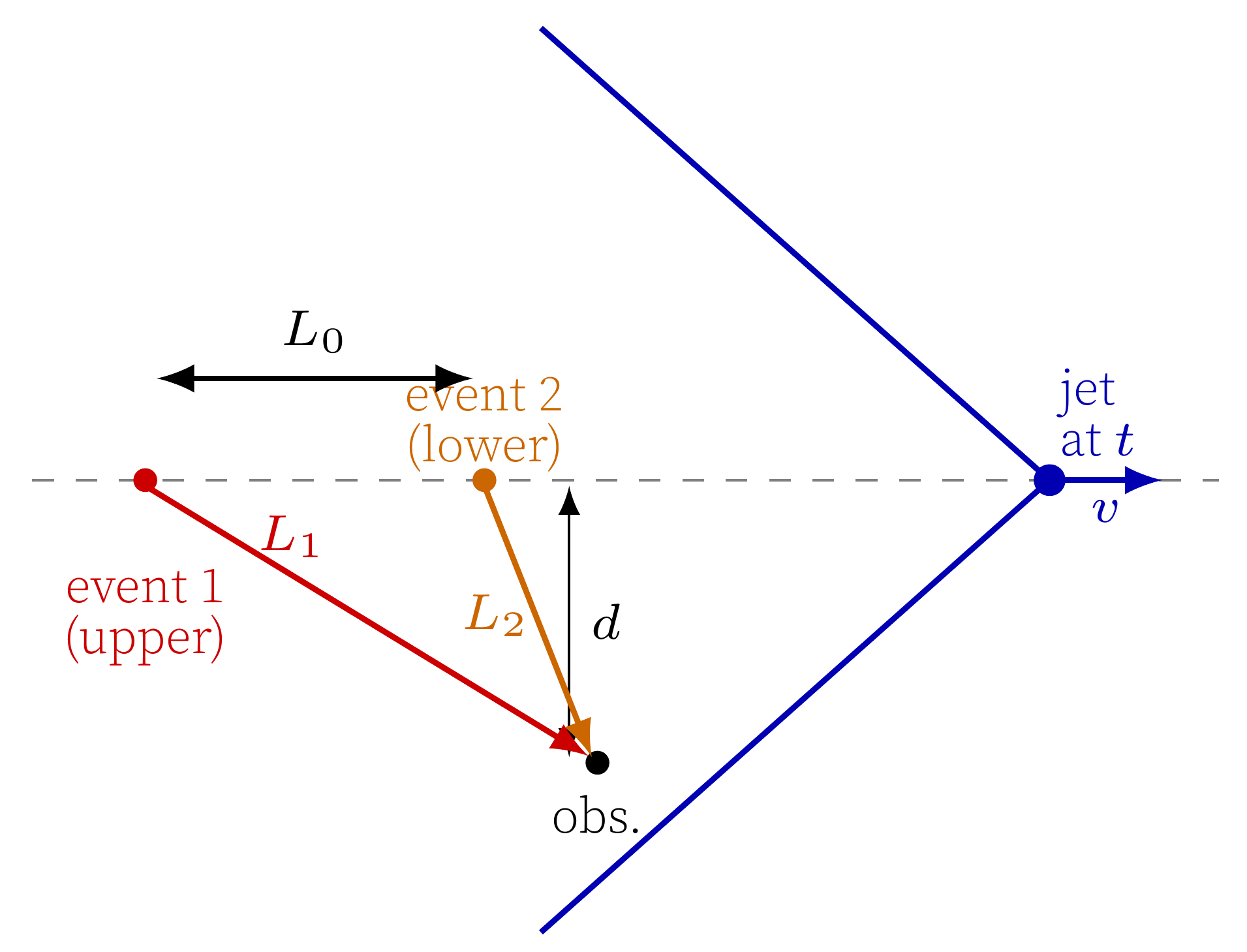
(c) Two simultaneous tones for . For each reception time (let us set ), two distinct past emission events 1 and 2 contribute. Suppose the sound from event 1, emitted at time from distance , reaches us now. Since the jet is supersonic, there is a second emission — event 2 at a later time , distance from us, separated from event 1 by distance along the trajectory — such that
i.e., the jet’s traversal time from 1 to 2 equals the sound delay . Both arrivals are Doppler-shifted, but to different degrees: the sound coming from behind (event 1, jet far upstream and approaching the observer) is blue-shifted (upper ridge), while the sound coming from ahead (event 2, jet receding past closest approach) is red-shifted (lower ridge).
(d) Ridges decrease in time. Both ridges diverge at the boom (the broadband spike at ) and decrease monotonically afterward, tending toward finite asymptotic values as .
Grading
- Silence before , explained as the sound not reached the receiver yet: 0.2 pts
- Sonic boom at , explained as the shock-wave front producing a short broadband pressure peak: 0.5 pts
- Associating the changes in frequency with the Doppler effect: 0.2 pts
- Explanation of two simultaneous tones for , with two emission events reaching the observer at the same time: 0.6 pts
- Explanation of ridges diverging at the boom and tending asymptotically to finite values as : 0.5 pts
Part ii) (3 points)
As , the jet’s velocity becomes nearly aligned with the line of sight, so the radial velocity (component along the line from source to observer) approaches . The classical Doppler formula for a source moving radially at speed relative to a stationary observer is
with the sign for an approaching source (, source moving toward observer) and for a receding source. Applied to the two asymptotic limits with :
Combining: and , so
Reading from the spectrogram: and . Therefore
Grading
- Recognising that the radial velocity tends to in the asymptotic limits: 0.5 pts
- Correct Doppler formula : 0.5 pts
- Asymptotic upper-ridge value : 0.2 pts
- Asymptotic lower-ridge value : 0.2 pts
- Reading and from the spectrogram (0.2p each): 0.4 pts
- Correct symbolic form : 0.8 pts
- Numerical answer : 0.4 pts
Part iii) (3 points)
The closest-approach signal is the sound emitted when the jet’s radial velocity is zero (jet directly overhead ). At that emission, , so the received frequency equals . From part (ii)‘s asymptotic relations we have
The observer hears this frequency on the lower ridge (the receding branch crosses as the jet passes overhead). Read from the spectrogram as the time when the lower ridge crosses .
Set at the moment the jet emits the sound that the observer eventually hears as the boom; call this position . Let denote the jet’s position when the observer hears the boom, and the observer. Then
and the boom-tangency condition fixes (the wavefront from just grazes the observer). In particular, , identifying as the Mach angle .
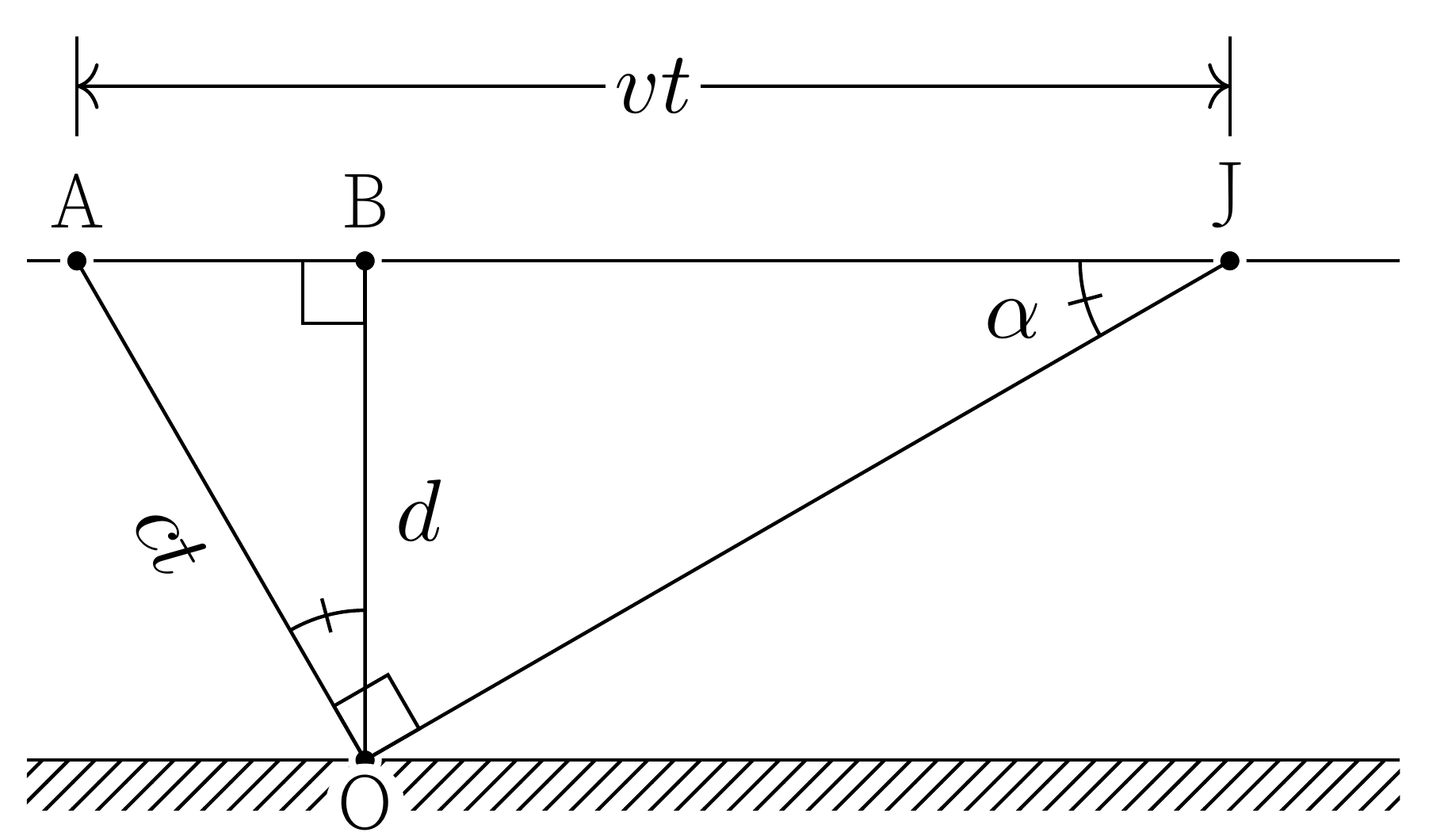
Let be the foot of perpendicular from onto trajectory , so (closest-approach distance). The right triangles and are similar (both right-angled, sharing the angle at ). From this similarity:
The observer hears the boom at time and the closest-approach signal at time . The lag is
Eliminating via and simplifying:
Reading from the spectrogram: (boom onset) and (lower ridge crosses ), so . With :
Grading
- Computing with using the asymptotes from part (ii): 0.4 pts
- Using Mach cone and the corresponding condition : 0.3 pts
- Recognising that at the point of closest approach, (no Doppler shift): 0.3 pts
- Expressing the time between the emission (event A) and reception of the sonic boom in terms of : 0.5 pts
- Expressing the time between event and reception of the wave emitted at in terms of : 1.0 pts
- Reading , from the spectrogram and computing : 0.2 pts
- Numerical answer if approach correct : 0.3 pts